Saturday, April 18, 2020

Is the market in recovery mode?

Today is the 31st day of the Moving Control Order in Malaysia. The COVIT-19 statistic for Malaysia seem to be positive and well under control. Refer to below chart as per updated on 17 April 2020 by The Star. The infected cases is down to two digit for the past 2 days, yesterday is at 69 new cases.It signified that the condition is getting better and better. Will there be no more Phase 3 MCO? 

Will this translate to better economy coming? Look at the world wide stock market below:

Everyone wants to know if the market is bottom at that time (23 March 2020), but there is no clear answer to this question even today. So today we are asking, if the market is rebounding strong now? What we can see that the expanding coronavirus pandemic pushed the market into bear territory earlier in March 2020.

In the meantime, almost all countries come out the stimulus plan to support the economy haven't been enough to sustain the lock down situation. Nothing can be move, everybody stay at home, money is not flowing to anywhere except digitally.

From the above table shown, since 23 March 2020, it keep going up till today. The rebound by the worldwide stock market off its March 23 coronavirus low is impressive, but is it going to be real and sustainable?

In our local KLCI, since the market last bottomed on the 23rd March when KLCI falls to a level of around 1260, it has rebounded some 140 points to end this week at 1407.

The market continued to breach one resistance line after another in the past few weeks. As a point of reference, the current KLCI levels right now is similar to what we've last seen in Sept 2011. Wow, that is 9 years ago, we are back to level of 9 years ago.
However, today situation is different from Sept 2011. What we are facing now is the worldwide health threat. The world is stand down, either Lock Down or restricted movement. No one travelling, flights are grounded, retail stores are closed, all events are stopped and a lot more.

Even if the lock down slowly open up, like Wuhan open up after 76 days, we are in 31 days since 18 March, the economy will not straight away back to the normal as we had last year. When will aggregate demand recover to pre-virus levels. The situation might be a lot dire now with unemployment almost at an all time high and many businesses going to close down.

As such, look at the current rebound rate, will it be second round of crashed? I think no one able to answer and we have to make our own judgement and prepare for it.



Sunday, April 12, 2020

Why we should invest into US markets?

As announced, the MCO will be extended to 28 April 2020 is to fight COVID-19
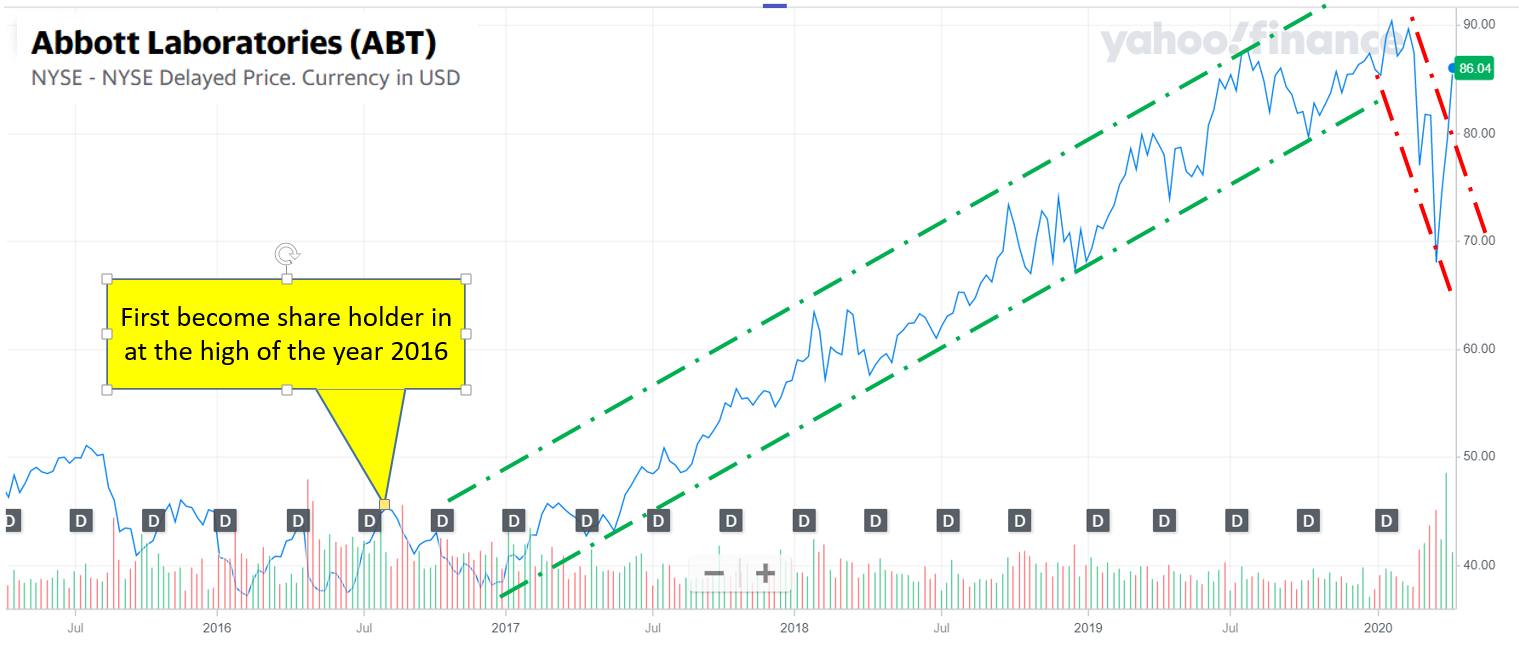
Since our MCO is extended for another 14 days on Phase 3, I tidy one of my drawer and saw my ex company share statement. This is my first time bought into the foreign shares.
In 2015, first time I venture out from my semiconductor industry and joined a green field newly setup company, Abbott Manufacturing Kulim. Abbott Manufacturing Malaysia gave me chance to own their share through ESPP (Employee Stock Purchase Plan).
29 Jul 2016 is the date of acquisition of the shares at USD 44.81 per share. Today Abbott Price is at USD USD 86.04. Refer to below the Price chart from Yahoo finance.

Still recalled my previous article sharing that one Abbott secretary who amassed a $7,000,000 fortune for charity by the time she passed away? If not, you can read from here.
During these past 2 weeks MCO, my another group chat is also discussion we should invest into US stock now. Extracted some of the text exchange as below:
Why we should invest into US markets?
Is natural that we Malaysian invest into KLSE locally and not foreign markets. We might think that investing in foreign markets could be risky.

a) Global Companies
A lot of worldwide companies that we known dailies is listed in USA stock market, for instance, VISA, Master, Starbuck, Pepsi, Coca Cola, Microsoft, Facebook, Google, Johnson & Johnson, Disney, Netflix etc. These are not available in local markets and we can buy a share to own them.

b) Most online  material
All of the above companies mentioned on section (a), a lot of research material are widely available online. Any research information need on the companies are easily available within seconds.

c) Huge market capitalization
In US market, closed to 200 billion traded daily. Just give a perspective on how big is their market compare to KLSE.
For KLSE, if all the listed 1000 plus companies added up their capital, it will sum up at around MYR 1.379 billion (~USD 322 billion) as of 31-March-2020.

Microsoft                 ~ USD 1,260 billion as of 12 April 2020
Google                    ~ USD   830 billion as of 12 April 2020
Facebook                ~ USD   499 billion as of 12 April 2020
Johnson & Johnson ~ USD 372 billion as of 12 April 2020
Visa                         ~ USD 373 billion as of 12 April 2020
Master Card            ~ USD 267 billion as of 12 April 2020
Coca cola                ~ USD   210 billion as of 12 April 2020
Pepsi                       ~ USD   185 billion as of 12 April 2020

Comparing our local market capitalization to just one companies like Facebook, Google and Microsoft, already far exceed to our total local capitalization. That is how big the US market.

d) Market Performance
Chart below can be self explainable on the market performance from 2010 till 2019 (10 years)
US market yearly return range from 18.1% - 35.7% whilst our local yearly return is about 2.4%

e) Currency devaluation
If we invest into US and should change our MYR to USD. Past 10 years the MYR has weaken yearly about 4%, whilst for SGD, is weaken about 2.5% ever year, refer to both chart below. 

The currency effect also makes it possible to make money if your stock did not perform well. The stronger the USD, it will be another booster to increased your investment return. Always remember that whenever you buy shares of a foreign stock, you’re actually making two investment decisions. You’re betting on both the performance of the company and the currency itself. The ideal scenario is being right about both: the stock price goes up, and you get an extra benefit from a strengthening of the currency. The worst-case: the stock goes down, and the currency loses value relative to the dollar. 

Based on the above five factors and with my initial investment to the Abbott Laboratries, it exhibit and proof that it was a right decision 4 years ago. Now will look into more in depth of US market.


Saturday, April 11, 2020

2nd largest Market Capitalization Stock in KLSE: TENAGA NASIONAL BHD (5347)

Last week I wrote on Maybank which is the biggest market capitalization in Malaysia. Today, I am writing on the second largest capitalization is Tenaga.
Snapshot below is the Top 100 Companies in KLSE by market capitalization on 11 April 2020. Tenaga is the second largest stock based on market capitalization in KLSE, with RM68.5 Billion. Based on the closing price on 110 April 2020,  the Price Earning ratio is 15.1 with Dividen Yield of 8.3%.

TENAGA is the largest player in generating and providing electricity in Malaysia. Tenaga Nasional Berhad is engaged in the generation, transmission, distribution, and sale of electricity in Malaysia. Its core business comprises- Generation division, Transmission division and Distribution division. If you do not know Tenaga, you are staying in the jungle probably. Tenaga also diversified geographically through equity ownership in the UK, Turkey, Saudi Arabia, Kuwait, India an Indonesia and Pakistan. Without electricity today, we all will be suffering like no air-conditioning running, our devices cannot be charged, no light, fan etc. So electricity is utmost essential after the Air, Water, Food, do you agreed.

Ok, enough introduction of Tenaga, let's focus on the stock valuation. From the stock chart from i3investor.com, the Peak price for Tenaga for past 5 years is at RM15.74 and already declines 46%. Year to date is drop 31%. Yesterday closed at RM12.04


Data from Morningstar:
Consistent growth in Revenue.
Consistent growth in Net income, drop in last 2 years
Consistent growth in Dividen with healthy payout ratio range from 26.75% - 80%
Free cash flow is positive for past 9 years.

As for the Dividen, there is increasing in term of the yearly dividen payout. Dividen payout ratio is range from 26.75% to 80%, a healthy and sustainable range.

As for the Dividen yield for past 5 years,
Max = 4.00%
Min = 2.18%
Ave = 3.41%
Current is 8.30% above the 5 years average


As for the PE ratio for past 5 years:
Max = 26.65
Min = 7.20
Ave = 16.00
Current is 16.54 which is above the Average

As for the P/B ratio for past 5 years, it stay above 1.2
Max = 1.79
Min = 1.01
Ave = 1.38
Current is 1.01 below the average

In Summary, in my personal opinion, electricity demand may drop during the MCO period due to Covid-19 but earnings could be unaffected. Tenaga’s earnings are expected to be sustainable at current level with stable cash-flow and dividend payout.

Sunday, April 5, 2020

Biggest Market Capitalization in KLSE Maybank 1155

While reading The Star newspaper yesterday, I saw a column Top 100 Companies in KLSE by market capitalization. Refer to below table extracted. Maybank is the largest stock based on market capitalization in KLSE, with RM83 Billion. Based on the closing price on 3 April 2020,  the Price Earning ratio is 10.1 with Dividen Yield of 8.6%.

Maybank is Malaysia largest bank and all Malaysian known the brand very well. If you are not familiar with Maybank, you must be a foreigner. Maybank is among the top 5 banks in ASEAN an international network of over 2,2000 branches and offices in 20 countries.
From the stock chart from i3investor.com, the Peak price for Maybank for past 5 years is at RM11.08 and already declines 36%. Year to date is drop 25%. So is the price is attractive now? Let's deep dive into the valuation in more details.

From the Financial chart below can observed that the Revenue is increasing every year. Profitability stay almost flat with slight decreasing on the profit margin.

As for the Dividen, there is increasing in term of the yearly dividen payout. Dividen payout ratio is range from 40% to 80%, a healthy and sustainable range.

As for the Dividen yield for past 5 years,
Max = 6.25%
Min = 5.27% ( Ex on April 2020, with RM0.39/share)
Ave = 5.78%
Current is 8.65% above the average


As for the PE ratio for past 5 years:
Max = 14.72
Min = 8.33
Ave = 12.7
Current is 10.1 which is below than the Average.

As for the P/B ratio for past 5 years, it stay above 1.1
Max = 1.6
Min = 0.9
Ave = 1.25
Current is 1.05 (RM7.4/RM7.05) below the average


Data from Morningstar:
Consistent growth in Revenue.
Consistent growth in Net income.
Consistent growth in Dividen with healthy payout ratio
Free cash flow is negative 10.56 mil ended last year. This could be a headwind to look into it.

In Summary, in my personal opinion, Maybank has a healthy growth.  It is not highly undervalue stock yet. Current price is just nice and able to tolerate the down side risk. This is not a buy or sell recommendation and purely is educational and discussion purpose only.


Saturday, April 4, 2020

What is the hardest hit industry of the COVID-19 Downturn

Today moving into 18th Day of the MCO in Malaysia. The good news in Penang is the new cases reported is down to single digit as of 1 April.

As of yesterday (3rd April) , there is no new cases reported and that is a good relief. Wish that our country new reported cases can down to 2 figure soon.

Since the outbreak of the COVIT-19 early of the year, there are few industries has been hit hard. The COVIT-19 outbreak has turned the economy into mess especially those companies in the travel and entertainment industries were the hardest hit.


1) Airlines Companies:
First hit the hardest is the airlines company, with the city or country lock down, there will be no people movement around. The air travelers air cutting down significantly. Air Asia and Malaysia airlines also taking the same precautious and grounded most of the flights to curb the spread of the virus. The star report is here.

a) Air Asia declines 51% year to date.
b) Malaysia Airport declines 43% year to date.
c) Singapore Airlines declines 41% year to date.
d) Others airlines
2) Entertainment & Tourism industry
Amidst the coronavirus pandemic, the global film industry is facing billions of dollars in losses as theatres are closed and films are postponed. Productions in Hollywood are also badly affected due to restrictions, which left many workers unemployed or forced to work from home. 

Planned concert will not able to go on. Ticket sales impacted and refund is necessary to the fans. On February 28, the hugely popular K-pop group BTS canceled a series of planned concerts in Seoul. The shows were scheduled for April 11 and 12 and April 18 and 19 at Seoul’s Olympic Stadium.

My favourite sport, NBA suspended basketball games indefinitely. I bought the SIA ticket to watch the 2020 Tokyo Olympics with my wife in July. On March 24, following pressure from athletes and multiple nations’ Olympic committees, the International Olympic Committee and Japanese prime minister Shinzo Abe announced that the 2020 Summer Olympics would be postponed, possibly until 2021; on March 30, the dates were set for July 23-August 8, 2021.
This is impacting my travel schedule and need to figure out from Singapore Airlines and requires to cancel all my booked hotels in Tokyo, Japan.

Hotels also suffering from the COVIT-19 due to no travelers, for example, Ipoh's Tower Regency Hotel shutters as Covid-19 proves final nail in coffin

a) Genting Malaysia declines 40% year to date.
b) Genting Berhad declines 39% year to date.

c) The Walt Disney declines 39% year to date.

d) Others companies in the entertainment being hit

I received a below information from social media and would like to upload here just for my future references. It will help me to remind me on this day when I look back sometime later.


What am I doing in past 2 economy Down turn

We are only 4 months into 2020 and it has already been a BIG year for all of us. Do you feel it? Right now, more than ever, investors need a plan to navigate this unprecedented market.
The bull market is officially over after the Covid-19 pandemic pushed fears to every major economy.
China, Europe, the US, Malaysia and none is spared. There are plenty of stocks at a "discount" right now which has down 30%, 50%, even 70% from their recent few months high! I truly believe that the first bear market since 2008 (more than 10+) could be a phenomenal investing opportunity — for investors who position themselves the right way.

Future may looks grim and most people are going to suffer financially over the next few months due to lock down and even years due to the COVIT-19 impact.

Dot-Com Crash:
In 2002 dot-com crash, I was working as Associate Technician and study part time in Singapore. At that time, the impact for me is minimal due to I am living in frugal to support my Bachelors degree fees. That is the final year that I requires to complete my thesis and fly to RMIT, Australia for presentation. There is not much saving in my account.

In that year, since it is down turn, I managed to buy a small hut in Singapore with a little Saving of SGD13,000. I have to exit the stock market before the dot com crashed. Count myself lucky at that time. Since then, I shunned away from stock market.

Subprime Crisis:
During the 2008 subprime crisis, I was working hard in my career back in Kulim time. I didn't invest in any stock. Still recalled that my Taiwanese boss ask me if I buy any stock or not? My replied was I did not and dared not too. That time, probably I missed the best timing to invest into the stock market. I only able to remember the Citibank share price plunges for nobody business. From below chart can observed that the peak is at USD550 per share in Feb 2001. During the Subprime crisis, it only worth USD15/share in Mar 2009. From there the share rebound till high USD80/share at Jan 2021.

 How about our Malaysia bank like Maybank at that time? Let's look at below chart for Maybank. From below chart can observed that the peak is at MYR 9 per share in Apr 2007. During the Subprime crisis, it only worth MYR 3.9/share in Apr 2009. From there the share rebound till high MYR 10/share at Jul 2018. Maybank has the same phenomenal with Citibank. I did trade for a few round for Maybank when it start to bounce back from RM4 to RM6. I did not learnt about the investing and only know how to buy low sell high for quick gain.


I did not pay a lot of attention with the stock market again for second time. However, I spend a lot of energy to learn property investment since 2010 till now. Past one year, I have begin to learn on the stock investing and this come the right time. Isn't this one of the golden opportunity to buy good companies and work for us?
There are some superb businesses are at a cheap sale and deep discount, it could be the best time to go for a shopping spree, that might elevate your financial well-being to the next level.
I am catching and boarding on this round of the downturn and capitalized it. How about you?

Sunday, March 29, 2020

Should you take up moratorium on your housing loan repayment?


During this COVIT-19 pandemic outbreak, I learn a new term which is “Moratorium”. When Bank Negara Malaysia (BNM) announcing this measures to help bank customers facing financial issues because of Covid-19, I was wondering what does it means? I did not know this is a term from finance. I never heard of this term for my life. It could be never happen in Malaysia or I was no need to worried about the financial when I was young.

I google it and simple explanation is “a legal authorization to debtors to postpone payment”, this will enables Malaysians to face the financial hardships during the COVIT-19 Movement Control Order (MCO) as a lot of business has to stop and not able to operates.

What does this Moratorium means for us? Below are the list available for reading if need more details.
Below will be high level of the table comparison from Uni Suites.

In this article, I focus only on the housing loan calculations as it will be impacting the majority for house owners.

For example, if your one month instalment is RM2,500, interest charged is RM1,700 and principal is RM800. Thus by taking 6 months moratorium, your potential 6 months cash flow saving will be as below:

Original instalment pay is RM2,500 x 6 months =RM15,000.
That means you will be having RM15,000 enable you to used as emergency fund if situation needed.

Plus you pay higher interest cause your principal did not reduce by RM800 per months during that 6 months .
Assume your interest rate is effectively 4.2%, calculation as follow:

Compounded 6 months interest will be around RM58.95 (rough estimation). I am not financial advisor and I just calculate based on manual compounded way.
Impact to your cash flow is you have extra RM2,500*6=RM15,000 and your cost is RM58.95 extra interest.

If I go to the website and key in relevant figure, the total compounded will be around RM69.58
http://moneychimp.com/calculator/compound_interest_calculator.htm

The key message here want to deliver is that the borrowing cost is so low and personally, I will take this approach for the next 6 months.
Imagine if you have 3 rental properties and tenants ask you to have free rentals, what will you do if you do not take up this moratorium from the banks? Will you able to survive for the next 6 months cash flow if there I no rental coming in? RM15,000 x 3 properties = RM45,000
It will be a huge amount, isn't it?

Another calculations to share as below:

Bear in mind that the moratorium on debt servicing payments will enable borrowers to have additional disposable income to spend or SAVE. The keyword is SAVE and invest into higher return opportunity during this down turn. Even if I can afford to continue servicing the loans, I will still take advantage of the moratorium to generate extra income by channeling to investments that produce higher returns than the debt servicing cost.

Given the low interest rates in servicing housing loans, the loan payments could give higher returns when invested in stock market since it is heavily hammered down now. Of course in depth due diligent requires to be done before putting your money into it.

Now, the decision is rely on you on whether to take up the moratorium by Bank or not. As mentioned, I don’t know how the pandemic is going to progress and how long it will takes, I will take up this moratorium offer to ease the cash flow and take opportunity to invest in the depressed stock market.